
I attended this year’s VeTSS Annual Conference 2026, held at the Royal Academy of Engineering in London in May with a dual purpose, as beside my interest in VeTSS, I was also one of the PhD students nominated to their annual VeTSS Doctoral Dissertation Awards.
It was not my first VeTSS event, and as always, it was a good opportunity to attend talks by high profile speakers, get an insight on what is happening across industry and government, and get to meet or catch up with colleagues and friends, all across a whole day of all things verification.
The talks were excellent. Kathleen Fisher (the CEO of ARIA) gave an inspiring keynote, calling the verification community to urgently shift from a reactive approach to security to one of built-in resilience. She made an excellent case for everyone to address the systemic vulnerabilities which make software too fragile for the needs of our increasingly complex, volatile and even hostile world. Kathleen then talked about her career and her current work at ARIA (the UK’s Advanced Research + Invention Agency) and its ambition to address these challenges. It was good to hear that the commitment and funding is there!
I also very much enjoyed Stephen Dolan’s talk (from Jane Street) on the new type system of OxCaml, though I may need to disclose a vested interest as one of the organisers of the Caml in the Capital user meet up. Stephen and his team are doing fantastic work extending OCaml with features allowing for more control over the memory, and more safety for concurrency. Dominic Mulligan (AWS) also gave a good overview of the Nitro Isolation Engine, an impressive amount of work done over the last 3 years where him and his team used a theorem prover to verify security properties of the Nitro hypervisor implemented in Rust (which runs all modern Amazon cloud compute). I had also been following that work for a long time, as my research focuses on Rust. I could go on and on about each talk, they were all deeply interesting.
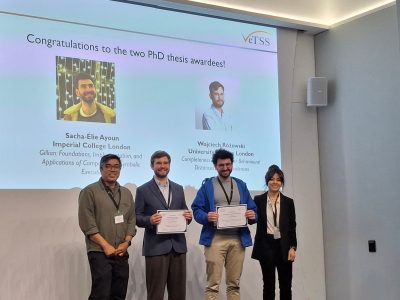
I also had the honour of receiving the 2026 VeTSS Doctoral Dissertation award for my thesis Gillian: Foundations, Implementation, and Applications of Compositional Symbolic Execution, in the excellent company of Wojciech Rozowski, whose thesis Completeness Theorems for Behavioural Distances and Equivalences won the Highly commended award.
Overall, it was a productive yet relaxed day, with talks from very different points of view, but each of them very relevant and engaging. It is really helpful to get together and to speak to people about the research they are just finishing, and I was happy to share ideas and plans. A very good event altogether, I am already looking forward to next year’s event.
By Sacha-Elie Ayoun

 by
by